
Public filings show you the tip of the private funds iceberg. Below the waterline, almost nothing about performance is visible.
Quick question: how many private funds exist?
Nobody knows for certain, and that’s the problem.
Some identifiers exist, but each covers a slice of the market, and nothing publicly ties them together. Fund names drift from one filing to the next, sometimes within filings from the same firm. “Acme Growth Fund III, L.P.” becomes “Acme Growth III” in one place and “Acme Capital Growth Fund 3” in another. Same fund, three names.
To benchmark private funds, you have to map more than the funds themselves. You need the managers, the vehicles, the filings, and the relationships between them. This is an ecosystem problem.
The CUSIP problem
Public markets solved identity decades ago. A CUSIP points to exactly one security, and every system agrees on what it means, whether you’re a custodian, a clearinghouse, or a data provider.
Private funds never got that. Even inside the SEC, identity is fragmented. EDGAR assigns a CIK to filers. Form ADV gives private funds their own identification numbers. Pension disclosures, data vendors, and GP reports each use their own labels, or none at all. When the identifiers don’t line up, everyone falls back on fund names, which are the least reliable field there is.
Think of endianness in computing. A multi-byte value can be stored big-endian or little-endian. The number never changes, but if you read it without knowing which convention was used, you get the wrong answer.

That’s private fund data today. Without an agreed convention for identity, the same fund becomes ambiguous the moment it crosses a system boundary.
Part of our benchmark buildout is establishing that missing convention: one consistent way to identify a fund across SEC filings, FOIA disclosures, and GP-reported data, so every fund resolves to a single canonical record.
What we just added
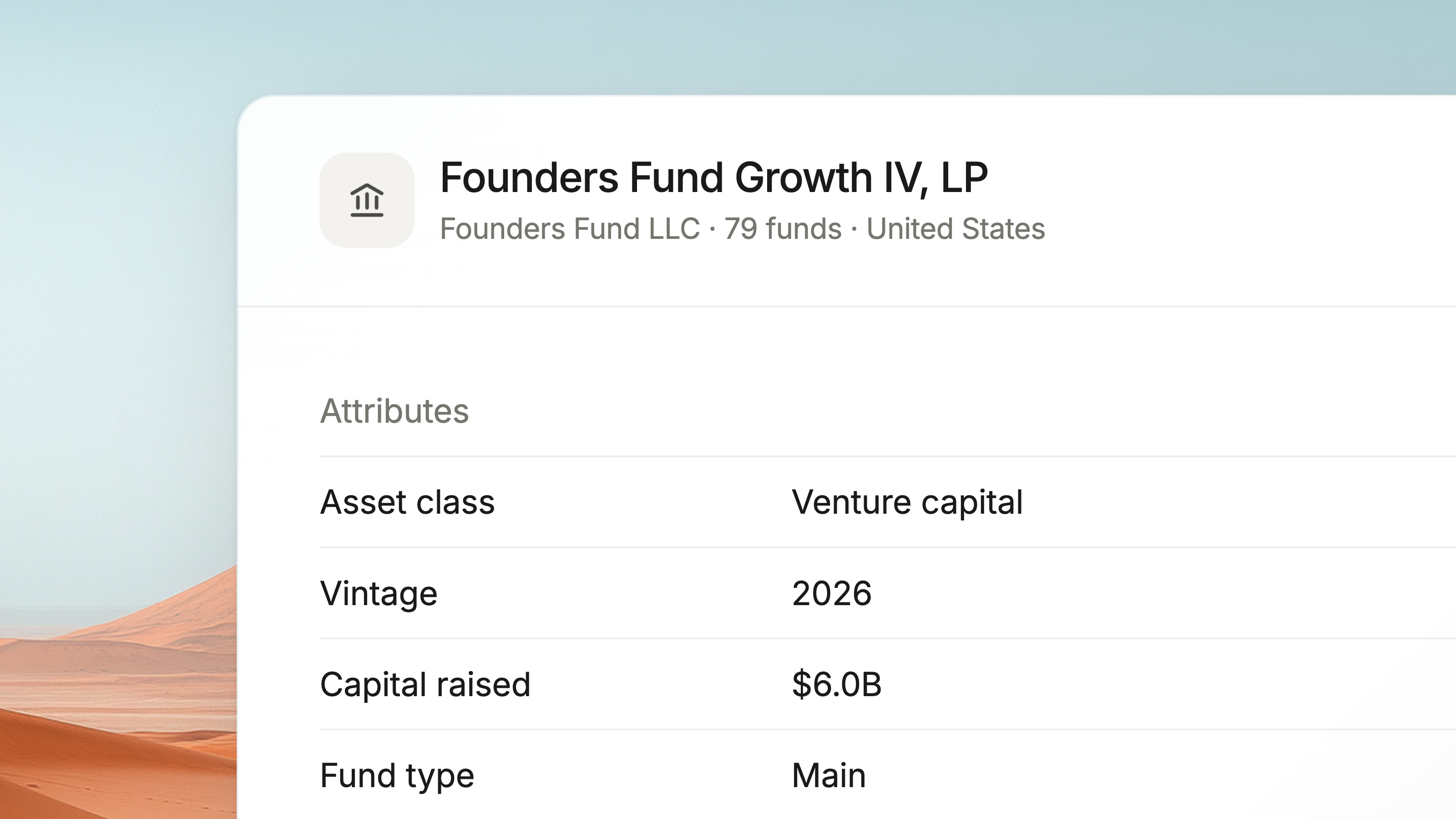
Our fund registry just grew by roughly an order of magnitude. We started with about 10,000 private fund records. It now includes every private fund that has filed with the SEC through Form D and Form ADV.

Here’s how the layers stack. The foundation was FOIA-based disclosures from public pension systems, which gave us fund-level investments and returns. We’ve now added SEC filing data, which gives each fund a formal identity to anchor to. Performance data meets identity data. That’s where mapping gets interesting.
The formation data tells its own story. Filings were not required electronically until 2009, so the early years are thin for reasons that have nothing to do with fund activity. Once filing began, the count climbs steeply.

One thread we’re pulling on: does fund formation track interest rates? We plotted formations against 10-year Treasury yields, and there’s a pattern worth a closer look. We’re not calling it a finding yet, but a question worth answering.
Below the waterline
Public filings tell you a fund exists. They tell you who’s involved, roughly how big it is, and sometimes what it claims to have returned.
That’s the tip.
What sits below is what benchmarking actually requires: cash flows. Capital called. Distributions paid. When each one happened.
This matters more than it sounds. A fund’s assets can rise because its investments performed well, or because new money walked in the door. From the outside, those two stories look identical. Without cash flow data, you can’t separate performance from fundraising.
That’s the gap Mantle Portal is built to close.
What’s next
This is a living system, not a finished product. Here’s what’s cooking.
A registry this size gets better with more eyes on it. We’re building ways for GPs and fund data owners to help complete and verify the records that belong to them, so the dataset sharpens as more of the industry engages. More on that soon.
You can explore the registry yourself in Mantle’s Fund Registry. Click into any fund to see what we’ve mapped so far. If something looks wrong, like a fund name, a manager relationship, or a filing attached to the wrong vehicle, you can report it right from the fund page.